1. Introduction
This article examines the economic growth targets announced in the election platforms of four major political parties contesting Nepal’s federal parliamentary election scheduled for 5 March 2026. It focuses on whether these targets are arithmetically consistent and economically feasible. The four major parties have announced the following objectives (all dollar figures are in US dollars):
· Rastriya Swatantra Party (RSP): Targets annual gross domestic product (GDP) growth of 7% in constant prices. Based on this growth trajectory, the party aims for GDP per capita to exceed $3,000 and the GDP to reach close to $100 billion in current prices within five to seven years.
· Communist Party of Nepal–Unified Marxist Leninist (CPN-UML): Targets annual GDP growth of 7 to 9 percent and expansion of the economy to Nepali Rupees (Rs) 10 trillion, while raising per capita GDP to $3,000 within five years.
· Nepali Congress (NC): Targets GDP of Rs 11.5 trillion and per capita GDP of $2,500 within five years.
· Nepal Communist Party (NCP): Targets double-digit economic growth, aiming for an annual growth rate exceeding 10 percent within five years.
Table 1 summarizes the growth targets announced by the major political parties in the first four columns, while the final two columns provide Nepal’s average annual GDP per capita growth rate over the past ten and five years.[i] The targets differ substantially in structure, time horizon, and precision, making direct comparisons difficult. The Rastriya Swatantra Party (RSP) specifies both a growth rate and a GDP level target, but over a flexible five-to-seven-year horizon. The Communist Party of Nepal–Unified Marxist Leninist (CPN-UML) specifies both a growth range and a GDP level target. The Nepali Congress sets GDP and per capita income targets without stating an explicit growth rate. The Nepal Communist Party (NCP) specifies only a growth rate, without linking it to a corresponding GDP level or time-bound income target.
Table 1 Political growth targets and Nepal’s recent historical growth performance
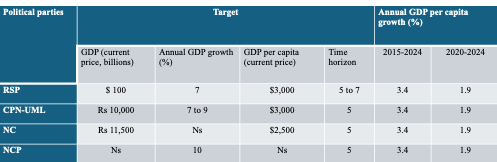
Note: Nepal’s GDP at current prices was approximately $45 billion (Rs 6,100 billion) at the end of 2025, with per capita GDP of about $1,500 (Rs 203,000). Ns: Not specified in the party platform.
As voters have grown increasingly skeptical after years of unmet promises, political parties have adjusted their language. Rather than traditional manifestos, they now speak of “commitments,” “guarantees,” and “contracts,” signaling greater intent and seriousness. But credibility does not arise from stronger words. It depends on whether the economic conditions required to achieve these targets actually exist. GDP targets themselves are not new. The difficulty has been that they were rarely met and seldom supported by credible implementation plans. This time is not much different. None of the parties has provided a detailed breakdown of how these targets would be achieved, leaving voters to rely largely on trust. More importantly, the arithmetic required to support these targets is rarely examined.
This analysis addresses that gap by examining whether the announced targets are internally consistent and economically achievable. It derives the growth rates required to reach stated GDP levels and, where targets are expressed only in GDP or income levels, computes the growth rates needed to achieve them. These implied and stated growth rates are then evaluated against Nepal’s historical experience and the performance of the world’s fastest-growing economies. The discussion proceeds sequentially, examining each party’s targets and their internal consistency. Using the lowest growth rate implied across party platforms as a representative benchmark, the analysis then evaluates whether Nepal’s economic structure can realistically sustain such growth.
2. Assumptions Used in the Analysis
Because the targets are expressed in a combination of current (nominal) and constant (real) prices, and in both US dollars and Nepali rupees, deriving the implied real GDP growth rates requires separating three components: real GDP growth, domestic inflation (as measured by the GDP deflator), and the exchange rate between the Nepali rupee and the US dollar. Of these, only real GDP growth represents genuine economic expansion; inflation and exchange rate movements affect nominal values rather than real output. Converting these targets into real economic implications therefore requires explicit assumptions about inflation, exchange rate movements, and population dynamics. Because the party platforms do not state these assumptions, the analysis adopts the following benchmarks:
Assumption 1. Inflation over the next five years follows its average rate over the past five years, which was 5.3 percent annually as measured by the GDP deflator.
Assumption 2. Although the Nepali rupee depreciated by about 4 percent annually over the past five years, the analysis assumes a stable exchange rate at the average level of 2025. This assumption favors the targets, since continued depreciation would require faster real GDP growth to achieve the same dollar-denominated GDP level.
Assumption 3. Nepal’s population remains approximately constant at its end-2025 level of 29.6 million, consistent with recent demographic trends.
3. Analysis of Targets
We begin with the Rastriya Swatantra Party (RSP). The first question is whether its stated real GDP growth target of 7 percent annually is internally consistent with its objective of raising GDP to $100 billion. By the end of 2025, Nepal’s GDP stood at approximately $45 billion. Reaching $100 billion by 2030 would require the economy to more than double in five years—an implied nominal growth rate of about 17 percent per year.[ii] Under the assumptions outlined above, achieving this target within five years would require sustained real GDP growth of 11 percent annually.[iii] If the Nepali rupee were to depreciate at its recent pace, the required real growth rate would be even higher.[iv]
By contrast, if the economy grows at the 7 percent real annual rate stated in the RSP platform, nominal GDP would reach only about $82 billion after five years, not $100 billion. At this pace, Nepal would reach a GDP of $100 billion only after about seven years. Achieving that level within five years would require sustained real growth of approximately 11 percent annually, not 7 percent. This creates an apparent inconsistency. One possible explanation is that the platform did not want to raise the growth rate above 7 percent, but to retain the memorable $100 billion figure as a headline anchor, it introduced a flexible five-to-seven-year timeframe.
We next examine the CPN-UML platform, which specifies both an annual real GDP growth rate of 7 to 9 percent and a target GDP level of Rs 10,000 billion. Because the target is expressed in Nepali rupees, exchange rate adjustments are not required. Nepal’s GDP at the end of 2025 was approximately Rs 6,100 billion. If the economy grows at the lower bound of 7 percent annually and inflation follows the assumed path, nominal GDP would reach about Rs 11,000 billion in five years—exceeding the stated target.[v] At the upper bound growth rate of 9 percent, nominal GDP would rise to approximately Rs 12,200 billion over the same period, exceeding the target by an even larger margin.
Why this mismatch between the stated growth rate and the GDP target exists is not clear. One possible explanation is that the platform assumes a lower inflation rate than in the past, though this is not specified. Under the maintained assumption that inflation follows its historical path, the stated growth range of 7 to 9 percent would result in GDP substantially exceeding Rs 10,000, making the GDP target internally inconsistent with the growth target. Furthermore, at a GDP level of Rs 10,000 billion, per capita income would be approximately $2,500—not $3,000—under the assumed exchange rate and population, creating an additional inconsistency.
Next, we examine the Nepali Congress platform. Unlike the other parties, the Nepali Congress does not specify a growth rate target. Instead, it sets a GDP objective of Rs 11,500 billion and a per capita GDP target of $2,500 within five years. Although not explicitly stated, this analysis assumes that these targets are expressed in current prices. One nuance is that the GDP target is stated in rupees, while the per capita target is expressed in US dollars.
Because both the GDP level and the time horizon are fixed, the implied growth rate can be calculated directly. Starting from GDP of Rs 6,100 billion in 2025, reaching Rs 11,500 billion within five years would require sustained real GDP growth of approximately 7.8 percent annually, given the assumed inflation rate.[vi] This GDP would imply nominal per capita GDP of approximately $2,700—slightly above the stated target of $2,500 , broadly consistent with it.
By not specifying an explicit growth rate target, the Nepali Congress platform avoids the internal inconsistencies observed in other party platforms. However, specifying an annual growth rate would provide a clearer and more transparent benchmark for voters to monitor. GDP and per capita income targets expressed in nominal terms are influenced by inflation and exchange rate movements, allowing greater flexibility in interpretation than a clearly defined real growth rate.
The NCP platform, by contrast, specifies only a real GDP growth target of 10 percent or higher annually. A growth rate provides a clear and meaningful anchor, avoiding the internal inconsistencies seen in other platforms. However, sustained double-digit growth would require a structural transformation far beyond Nepal’s recent experience, and the basis for such an assumption is not specified.
Taken together, the four party platforms imply sustained real GDP growth expectations ranging from about 7 percent to more than 10 percent annually, though the economic arithmetic underlying these targets differs substantially. The RSP’s stated growth rate of 7 percent would not produce a $100 billion economy within five years and would instead reach that level only over a longer horizon, such as seven years, or require a higher growth rate of approximately 11 percent. The CPN-UML’s Rs 10,000 billion GDP target is arithmetically achievable within five years under its stated growth range, but achieving its per capita income objective would require a growth rate of 9 percent. The Nepali Congress target implies sustained real GDP growth of approximately 7.8 percent annually, while the NCP specifies only a growth rate exceeding 10 percent without linking it to a corresponding GDP level.
4. What do These Growth Rates Imply?
Despite differences in how targets are framed, a common benchmark emerges: real growth rates range from about 7 percent to as high as 11 percent annually. The analysis that follows focuses on sustained real GDP growth of 7 percent—the lowest rate implied across party platforms—and examines what such growth would require in practice. Even this benchmark lies well above Nepal’s historical experience and at the upper end of global performance, typically observed only during exceptional periods of structural transformation among the world’s fastest-growing economies.
Over the past three decades, Nepal’s real GDP per capita growth has averaged only about 3.1 percent per year. In the last decade, it averaged 3.4 percent, and over the past five years, just 1.9 percent. Over the past sixty-five years, growth reached or exceeded 7 percent in only three years, underscoring how rare such performance has been. Sustaining growth at that level would therefore require Nepal not only to more than double its recent long-term performance, but to maintain that acceleration continuously over many years, rather than achieving it sporadically. If sustaining 7 percent growth already requires such structural transformation, the feasibility of higher growth targets becomes correspondingly more demanding.
Global experience underscores how demanding such growth would be. Using data since 1995 and excluding oil-dependent economies and small economies with GDP below $15 billion in 2024, I examine the performance of the world’s five fastest-growing economies in each decade. Their average annual real GDP per capita growth was 9.8 percent during 1995–2004, 9.0 percent during 2005–2014, and only 5.6 percent during 2015–2024. Over the most recent five-year period, it declined further to just 5.4 percent. Sustained high growth has slowed even among the world’s strongest-performing economies.
In this context, sustaining real GDP per capita growth of 7 percent would place Nepal not merely above its own historical experience, but above the recent performance of the world’s fastest-growing economies. As shown in Figure 1, Nepal’s per capita growth historically lagged global leaders by wide margins. In the late 1990s and early
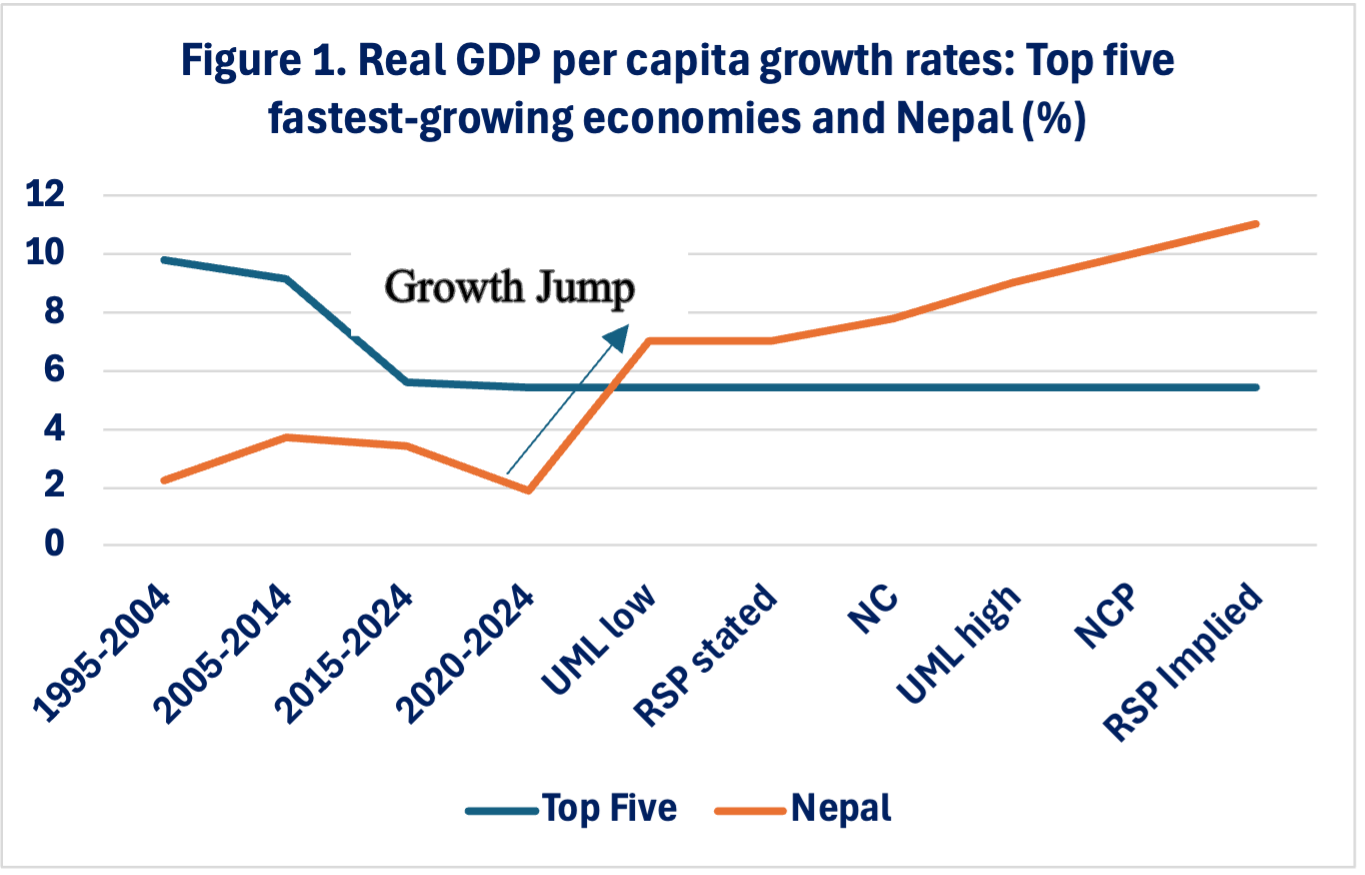
2000s, the gap was as large as eight percentage points annually. Even in the past five years, when global growth had already slowed, the fastest-growing economies expanded nearly three times as fast as Nepal. Achieving 7 percent growth—the lowest target implied in political platforms—would not merely close this gap; it would reverse it, placing Nepal about 30 percent above the recent global frontier.
Such a shift would be extraordinary. It would elevate Nepal from a persistent laggard to one of the world’s fastest-growing economies by a wide margin. Higher targets of 9 or 10 percent, as proposed in party platforms, would represent an even more dramatic break from both Nepal’s historical performance and global experience. Sustained per capita growth at that level has been achieved only rarely by growth leaders, and during periods when the global economy was more open to trade, capital flows, and industrial expansion than it is today. In recent years, as we saw, even the world’s five fastest-growing economies have averaged only about 5.4 percent annually. The constraint, in other words, is not ambition. It is arithmetic.
5. What is the Investment Need?
Even the lowest growth rate targeted in political platforms would represent a historic acceleration for Nepal. The critical issue, however, is whether such growth is internally achievable given the economy’s investment capacity and structural constraints. Sustaining real GDP growth of 7 percent annually would require a substantial expansion in investment. Nepal’s incremental capital–output ratio (ICOR)—the amount of investment needed to generate one unit of additional output—has averaged about 7 over the past decade. This represents a relatively favorable benchmark, as capital productivity has weakened in recent years, with ICOR rising to around 10 over the past five years.
Using the more favorable decade-average ICOR of 7, sustaining 7 percent growth would require an investment rate of approximately 49 percent of GDP—an extraordinarily high level by both historical and international standards.[vii] Nepal’s actual investment rate has averaged only about 29 percent of GDP. The gap is therefore not marginal or temporary; it is structural. Such a sustained increase would be unprecedented in Nepal’s history and would exceed the experience of even the world’s fastest-growing economies. No modern economy has maintained investment rates of this magnitude.
An investment rate of 49 percent of GDP would imply total investment of approximately $136 billion over the next five years (in constant 2025 dollars).[viii] For perspective, Nepal’s total investment over the past five years was only about $54 billion. Achieving the proposed growth target would therefore require investment at roughly two and a half times recent levels. The constraint, once again, is not ambition. It is arithmetic.
This arithmetic also underscores the critical role of investment efficiency. Nepal’s ICOR has averaged about 7 over the past decade and has risen to around 10 in recent years, indicating declining efficiency in converting investment into output. By comparison, ICOR in many developing economies typically ranges between 3 and 5. While improvements in efficiency could reduce the investment required to sustain growth, such gains occur gradually and cannot be assumed. Even maintaining an ICOR of 7 represents an optimistic benchmark in Nepal’s recent context. Without sustained improvement in both the scale and efficiency of investment, the arithmetic does not support the growth rates implied in political platforms.
Even the current investment rate is sustained largely by remittance-driven inflows rather than domestic productive capacity. Domestic saving remains exceptionally low—around 6 percent of GDP—among the lowest in the world. As a result, Nepal’s existing investment is already heavily dependent on external resources. Sustaining significantly higher investment rates would therefore require either a fundamental shift in domestic saving behavior or a sustained expansion of external financing, neither of which is evident at present.
The constraint, therefore, is not simply the availability of financial resources, but the economy’s limited capacity to mobilize and convert them into productive capital formation at the scale required. Closing such a gap would require not incremental improvement, but structural transformation in Nepal’s investment environment.
Borrowing is often viewed as an alternative source of financing. In principle, external borrowing can supplement domestic resources. But borrowing does not create productive capacity by itself; it merely shifts resources across time. Its effectiveness depends entirely on whether funds are invested in projects that raise future output. Nepal’s experience raises concerns in this regard. Much past borrowing has financed consumption, recurrent expenditure, or low-productivity projects rather than investments capable of generating sustained returns. Without stronger institutional capacity to allocate and execute investment efficiently, higher borrowing risks increasing debt without increasing growth.
Foreign direct investment, another potential source of capital, has remained persistently low. Nepal’s geography, small market size, and structural constraints limit its attractiveness as a major destination for large-scale investment. These challenges are compounded by policy unpredictability, regulatory uncertainty, and weak enforcement of the rule of law, which increase investor risk and discourage long-term commitments. As a result, FDI cannot be relied upon at the scale required to sustain rapid growth. Foreign aid, while useful, remains modest relative to the investment required and cannot substitute for sustained domestic saving and private investment.
The arithmetic is therefore unavoidable: sustaining real GDP growth of 7 percent would require a dramatic increase in productive investment, far beyond Nepal’s historical levels and far beyond what the economy has been able to mobilize. No credible source of financing exists at that scale. Investment, however, is only the minimum condition for sustained growth. Capital must be complemented by skilled labor, capable firms, productive technologies, and institutions able to allocate and execute investment efficiently. Even if investment were available at the required scale, Nepal would still need a simultaneous expansion in these complementary capacities. Without them, capital cannot be translated into sustained output growth.
Taken together, these constraints define the limits of what the economy can achieve. Until Nepal undergoes structural transformation in its investment capacity and institutional foundations, sustained real GDP growth of 7 percent is not achievable. The constraint is not ambition. It is arithmetic.
6. Conclusion
This analysis does not argue against ambition. Nepal needs faster growth, higher investment, and structural transformation. But growth emerges only from systems capable of mobilizing capital, allocating it efficiently, and converting it into sustained productive output. Even the lowest growth target implied in political platforms—7 percent annually—would place Nepal among the world’s fastest-growing economies. Sustaining such growth would require investment equivalent to roughly half of GDP, far above Nepal’s historical level of 29 percent and beyond what even most high-growth economies have sustained. The constraint, therefore, is not merely financial. It is structural.
Even under the most favorable scenario, where governance improves, investment efficiency rises, and the foundations of growth are strengthened, Nepal’s sustained real GDP per capita growth is unlikely to exceed about 5 percent annually over the next five years. A growth rate of roughly 4½ percent represents an optimistic but plausible scenario. At that pace, real GDP per capita would rise from about $1,500 in 2025 to roughly $1,900 by 2030 in today’s prices, making Nepalis approximately 27 percent richer in real terms. With 5.3 percent annual inflation and a stable exchange rate, nominal GDP would increase from approximately $45 billion to about $72 billion over the same period. At this rate, Nepal would reach a $100 billion economy only around 2034—not by 2030.
There is also a deeper political economy reality. In competitive democracies, ambitious targets signal intent and optimism. But when targets exceed economic capacity, they cease to function as plans and instead become slogans. Serious economic policymaking requires grounding targets in arithmetic before announcing them. When growth targets are set without regard to the underlying investment, productivity, and institutional requirements, they become declarations of intent rather than operational plans. Over time, repeated gaps between promise and outcome do not accelerate development—they erode credibility and weaken the foundation on which sustained growth depends.
Nepal’s challenge, therefore, is not a lack of ambition. It is the need to align ambition with arithmetic, and aspiration with institutional capacity. Sustainable prosperity will not come from announcing higher growth targets, but from building the economic systems capable of achieving them. Until those systems are firmly in place, targets that exceed economic capacity will remain slogans rather than outcomes. Ambition may shape slogans, but arithmetic determines outcomes.
[i] The lower growth rate over the past five years, relative to the decade average, partly reflects the contraction in 2020 due to COVID-19. However, given the expected rebound following such a shock, the continued weakness indicates that the slowdown cannot be attributed solely to the pandemic but also reflects underlying structural fragility in the economy.
[ii] This requirement follows directly from the compound growth formula. GDP evolves according to: Y2030 = Y2025 (1 + gₙ)5 where Y denotes GDP measured in dollar, the subscripts indicate the year, gn is nominal annual GDP growth rate. Solving it we have gₙ = (100 / 45)1/5 – 1 which yields GDP growth rate ≈ 17% per year.
[iii] This is obtained by using the formula, (1 + gₙ) = (1 + π)(1 + gᵣ), where gr is real GDP growth rate, π is annual rate of inflation. Solving: gᵣ = [(1 + gₙ) / (1 + π)] – 1, gᵣ = [(1.17 / (1.055] – 1 = 11.4% per year.
[iv] This relationship can be approximated using the following identity: gᵣ(Rs) = gᵣ($) + ε, where the real GDP growth rate in Nepali rupees is measured by gr(Rs), and in in US dollars by gr($), and ε is the rate of exchange rate depreciation (defined as the annual percentage increase in Nepali rupees per US dollar). Substituting the values gr(Rs) =11% + 4% = 15%. Under a stable exchange rate, ε=0), the required real GDP growth rate would remain at 11% per year. For clarity, we went step by step but these two adjustments—inflation and exchange rate depreciation—can also be incorporated in a single step using the following identity: (1 + gn$) = [(1 + π)(1 + gr(R))] / (1 + ε) and solving for real GDP growth in Rs: (1 + gr(R))).
[v] Using the equation (1 + gₙ) = (1 + π)(1 + gᵣ), we have (1 + gₙ) = (1.07)(1.053) =1.1267. then using compound growth rate formula, GDP2030 = 6,100 ×(1.1267)5 ≈ 6,100 × 1.814 ≈11,000 billion.
[vi] Using the compound growth formula,1 + gn = (11,500 / 6,100)1/5 ≈ 1.135, implying nominal GDP growth of 13.5 percent annually. Adjusting for inflation using 1 + gn = (1+gr)(1+π) and assuming inflation of 5.3 percent yields 1+ gr = (1.135 / 1.053) = 1.078 or real GDP growth of 7.8 percent per year.
[vii] This investment requirement can be computed using the following relation: ICOR = (Investment / GDP) / GDP growth rate. Rearranging: Investment rate = ICOR × GDP growth rate. Assuming ICOR = 7 and a real GDP growth target of 7% per year: Investment rate = 7 × 7% = 49% of GDP.
[viii] This figure can be derived from the projected GDP and investment paths implied by the growth target. Real GDP evolves according to: Yₜ = Y₀ (1+gr)ᵗ, where t =1,2,…,5 Y0 is GDP in 2025 ($45 billion in constant 2025 prices); and gr is the real GDP growth rate, assumed to be 7% per year. Substituting successive values of t yields the GDP level for each of the next five years. Required investment in each year is then given by It = 0.49 × Yt. Summing investment across the five-year period produces a total requirement of approximately US$136 billion.